
JURA vs Gaggia Office Coffee Machines: Which Platform Fits Your Workplace?

Choosing between JURA and Gaggia for an office starts with the workplace: actual drinks per day, the busiest half-hour, milk preference, chocolate, water access and who will care for the machine. There is no universal winning brand. A compact fresh-milk JURA can be right for a coffee-led office; a Gaggia configuration can be stronger when soluble ingredients or heavy self-service demand matter.
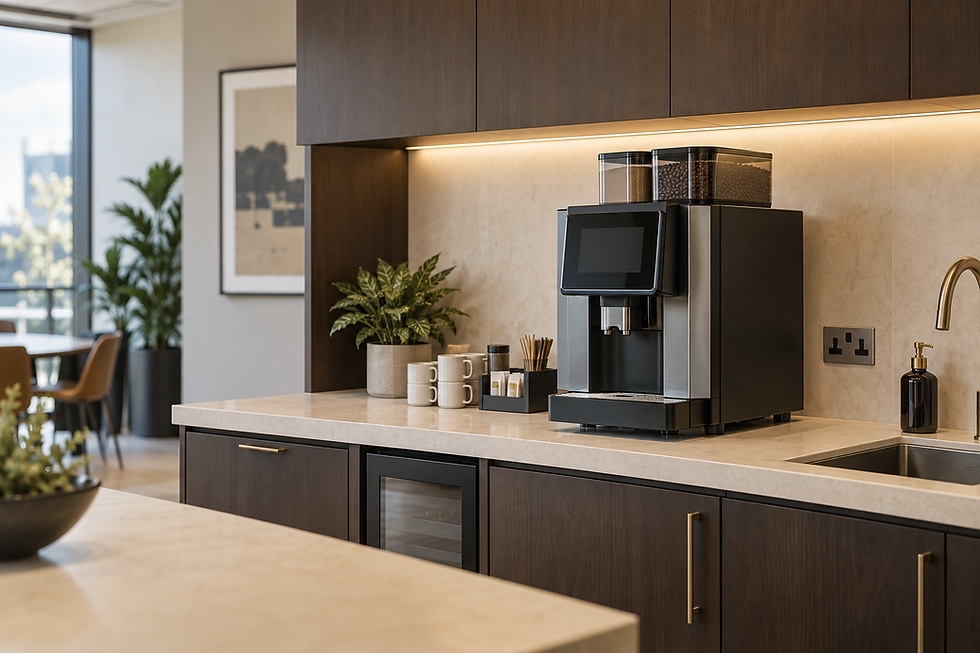
The practical shortlist: W8 for up to 50 daily coffees; X10/X10c or G100 around the 100-cup class; GIGA X3 or G300 around 150; GIGA X8 around 200; G700 up to 300 in the current English Gaggia specification. These are manufacturer demand classes, not employee limits or a guarantee of short queues.
For the detailed calculation, use our office coffee machine size guide. If you have already narrowed the choice to two compact JURA models, go directly to the JURA W8 vs X10 comparison. This guide deals with the wider platform decision.
JURA vs Gaggia: what actually changes?
The JURA models considered here grind beans and use fresh milk for milk drinks. They suit a brief centred on espresso and milk-coffee quality, with W8 and X10 offering compact professional formats and the GIGA line adding capacity and, on X8, a second grinder. Milk still needs suitable chilling and a daily cleaning routine.
Gaggia’s range spans more operating models. G100 is offered in fresh- or powdered-milk versions; G300 is a larger powdered-milk/soluble-ingredient platform; G700 is a much larger fresh-milk platform with optional DualMilk on the appropriate version. A canister count does not tell you what ingredient a UK quotation includes. The exact recipe, milk system, accessories and installation must be specified.
A plumbed connection saves water refills where a route exists, but it does not increase the daily rating. A larger machine can add ingredient and waste headroom yet create an oversized tea point for a small team. Compare the full OBS machine range alongside this guide.
Seven machine families at a glance
On a phone, swipe the table sideways. Daily figures are manufacturer recommended maximums for JURA and suggested output for Gaggia. Mixed menus and morning peaks require a separate check.
Machine / daily class | Milk and chocolate | Water | Best fit and reason to look elsewhere |
JURA W8 • up to 50 | Fresh milk; no integrated chocolate | 3 L tank | Compact premium coffee point; step up if daily use or refills outgrow it. |
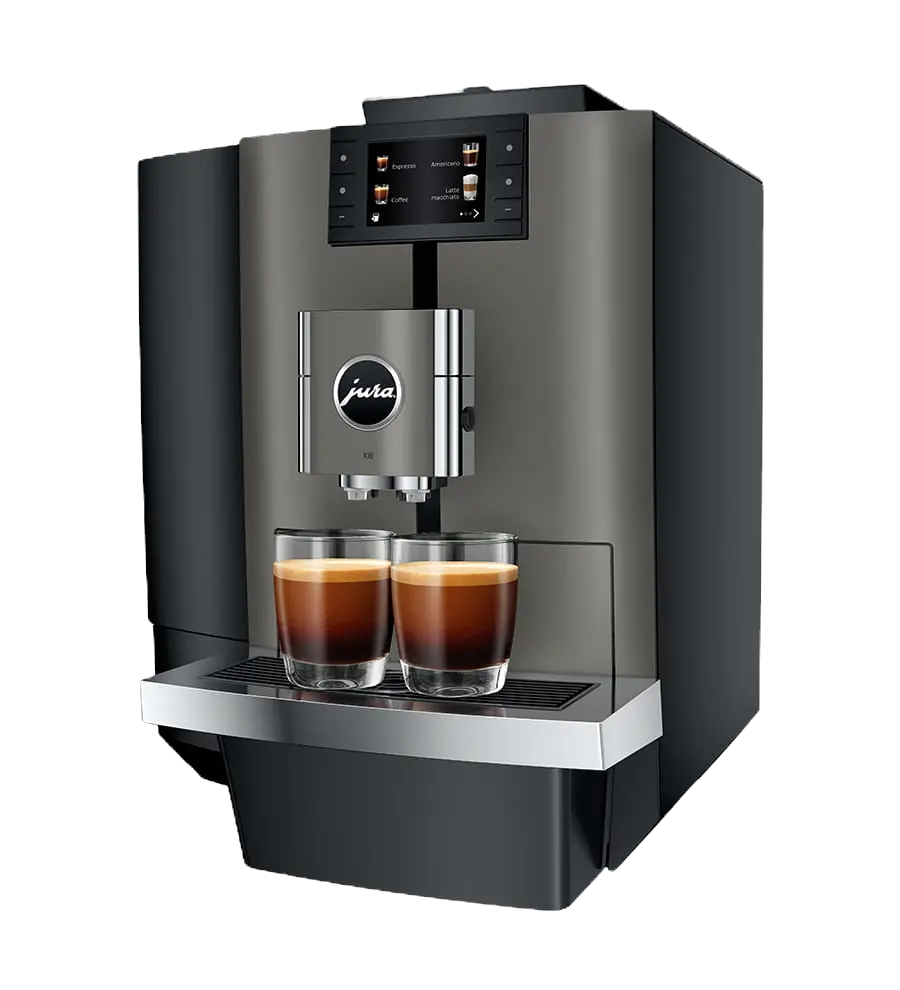
JURA X10 / X10c • up to 100 | Fresh milk, Cold Brew; no integrated chocolate | X10 tank; X10c mains | Growing coffee-led office; G100/G300 if soluble milk or chocolate matters. |
JURA GIGA X3 / X3c • up to 150 | Fresh milk; no integrated chocolate | X3 tank; X3c mains | Busy single-bean coffee point; consider X8 for regular two-bean demand. |
JURA GIGA X8 / X8c • up to 200 | Fresh milk; no integrated chocolate | X8 tank; X8c mains | Large premium coffee point, two grinders; check whether two points serve floors better. |
Gaggia G100 • up to 100 | Fresh or powdered version; chocolate only with specified soluble setup | Mains; confirm optional tank kit | Flexible medium office; avoid assuming fresh-milk version makes chocolate. |
Gaggia G300 • up to 150 | Powdered milk; chocolate with specified soluble setup | Mains in OBS range | Busy self-service menu; consider a fresh-milk platform if texture is central. |
Gaggia G700 • up to 300* | Fresh milk; optional DualMilk; chocolate with specified canister/recipe | Mains in OBS range | Large high-footfall site; size, cost and care can be excessive for a normal small office. |
*Gaggia’s current English G700 page gives up to 300 cups/day. Some regional product pages and OBS material use a 250 recommended / 300 upper distinction and different hardware dimensions. Confirm the exact UK version and sustained use case in the written quotation.
Which JURA platform fits?
W8: compact fresh-milk coffee
Choose the JURA W8 for a smaller professional office, showroom or client-facing coffee point that values espresso, cappuccino and flat white, makes comfortably fewer than its 50 daily coffees, and can refill a 3-litre tank. It is a proportionate choice when the room and user count do not justify a bigger unit.
Do not choose it for recurring demand beyond that class, a mandatory fixed water supply, Cold Brew or automatic chocolate. The X10/X10c is the logical JURA step up; our W8 vs X10 buying guide explains the closer call.
X10 / X10c: wider menu and 100-cup class
The JURA X10 and X10c add the 100-cup class and cold-extracted coffee specialities to the fresh-milk offer. X10 uses a manually filled 5-litre tank; X10c is the permanently connected variant. A water connection changes the refill routine, not the 100-cup demand class.
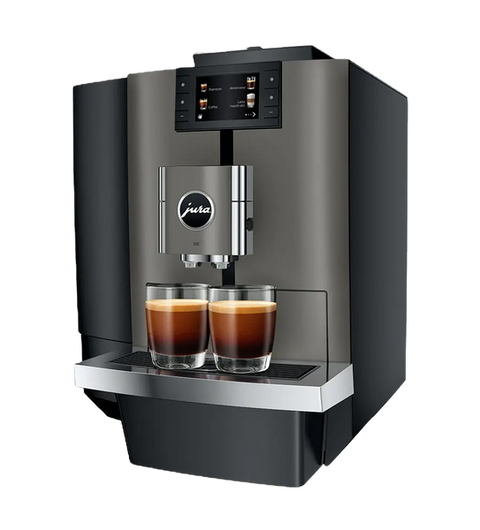
Where hot chocolate, powdered milk or a larger ingredient store matters more than Cold Brew, compare a specified G100 or G300. Where daily drinks and morning peaks exceed the X10 brief, assess GIGA X3 or distributed points. Build an X10 package after choosing the model; specify X10c and its mains requirements with OBS.
GIGA X3 / X3c: higher demand with one main bean
The GIGA X3 and X3c move into the 150-cup class with a commercial ceramic grinder, fresh milk and a larger bean supply. This is useful for a busy single-bean professional coffee point, not simply an X10 with a bigger tank. X3 is tank-fed; X3c is the mains-connected version.
If staff regularly need decaf as a second whole-bean choice, compare X8’s two grinders. If powdered milk and chocolate are central to the brief, G300 is a more meaningful alternative than buying a higher JURA class that still lacks a soluble chocolate route.
GIGA X8 / X8c: two grinders and 200-cup class
The GIGA X8 and X8c reach JURA’s 200-cup daily class and use two independent grinders. They suit a large coffee-led office that wants regular and decaf beans on demand, a broader professional setup and peak-time headroom. X8 is tank-fed; X8c is plumbed.
At a headquarters with several floors, one X8 can be less convenient than two correctly sized points. Map where people actually work, meeting peaks and resilience during cleaning or a fault before putting all demand at one counter. Neither GIGA model is an integrated hot-chocolate machine.
Which Gaggia platform fits?
G100: configuration flexibility without a huge platform
The Gaggia G100 is a narrower commercial machine in the 100-cup class. The manufacturer offers fresh-milk PrimeMilk and powdered-milk versions; the 7-inch screen and removable brewing group suit self-service and care. Its narrower body does not remove the need for ingredient, fridge and maintenance space.
Hot chocolate is a configuration question. OBS offers it with an appropriate granulated/soluble setup; a fresh-milk G100 is not automatically a chocolate machine. Confirm canister allocation, the recipe and the exact UK water kit. OBS presents a mains connection with an optional tank arrangement that should be quoted explicitly.
For the deeper decision within this pair, see G100 vs G300. A smaller office making few coffees may still be better served by W8 than by the G100’s greater flexibility.
G300: powdered milk and a busier self-service menu
The Gaggia G300 deserves consideration when a busy workplace wants freshly ground coffee, powdered milk and a specified chocolate recipe from a single self-service point. Gaggia’s current English specification gives up to 150 cups/day, a 10-inch touchscreen and multiple soluble-ingredient versions. OBS supplies it as a plumbed machine.
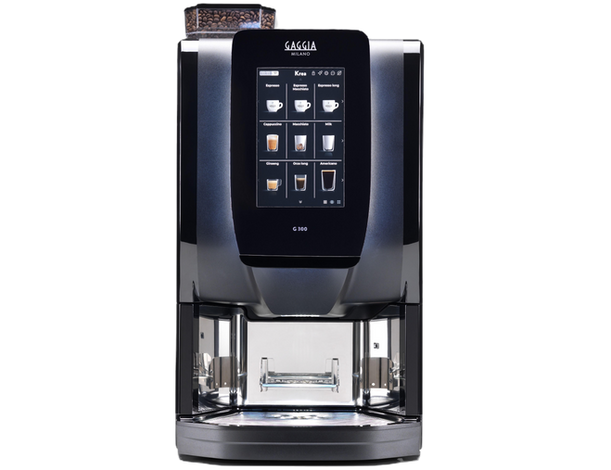
It avoids fresh-milk refrigeration and milk-path handling, but still needs bean and ingredient replenishment, mixer cleaning, waste emptying and service access. Ask which canister holds milk and which holds chocolate. If café-style fresh milk is non-negotiable, assess X10 or GIGA X3 at the right volume instead.
The G300 Quote Builder package opens with this machine selected so you can compare purchase, lease, installation and support.
G700: a materially larger fresh-milk platform
The Gaggia G700 is for a large HQ, high-footfall catering point or demanding managed workspace where its scale is justified. Current English Gaggia material positions it up to 300 cups/day. EvoMilk prepares fresh-milk foam, and appropriate versions can add DualMilk for two milk types. Suitable soluble canisters can support chocolate if the exact build and recipe are specified.
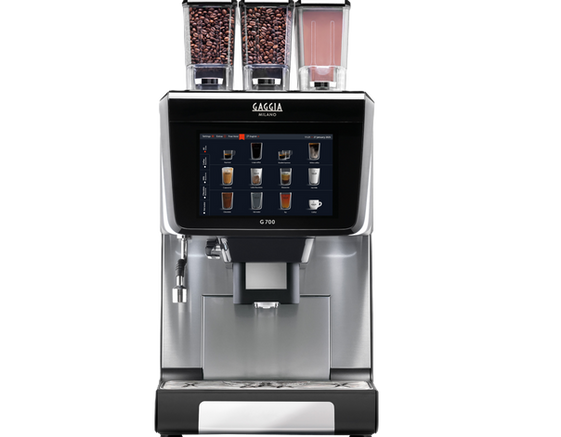
This is substantially bigger operationally than G100: check the full installed footprint, cooler, water, drainage, power, ingredients, cleaning owner and service route. A small office should not buy this class merely to obtain fresh milk plus chocolate. A proportionate smaller coffee setup with a separate chocolate route may be better.
Useful head-to-head decisions
W8 vs G100
Both may appear on a smaller office shortlist. W8 wins the case for compact, tank-fed, coffee-led fresh-milk service within 50 daily coffees. G100 becomes interesting around the 100-cup class, a specified powdered-milk/chocolate menu or mains-fed commercial operation. A fresh-milk G100 is a separate configuration, not shorthand for chocolate.
X10 vs G300
A growing workplace could consider both, but the milk and menu usually decide: X10 brings fresh-milk drinks and Cold Brew in a 100-cup class; G300 brings a powdered-milk and chocolate route with 150-cup suggested output and a larger self-service interface. Check actual peaks; the extra 50-cup rating is not an hourly speed claim.
GIGA X3 vs G300
Both sit around a 150-cup daily class. Choose the GIGA X3 path when fresh-milk coffee quality and one main bean dominate. Choose the specified G300 path when powdered milk, chocolate and ingredient capacity make daily operation easier. The site’s milk routine, refrigeration, water route and recipe mix decide more than their similar headline class.
GIGA X8 vs G700
A large site may compare X8’s two grinders and 200-cup fresh-milk JURA offer with G700’s larger fresh-milk platform, optional two-milk route and a chocolate-capable configuration. G700 adds site and operating demands. If demand is spread across floors, compare several smaller points before assuming either one central machine is enough.
Milk and chocolate: specify the actual recipe
Fresh milk normally improves the milk texture and presentation many workplaces expect, while powdered or granulated ingredients avoid refrigerated milk storage and change daily care. Neither format is universally easier in every respect. Read the fresh milk vs powdered milk guide for the detailed trade-offs.
None of the seven JURA configurations here includes an integrated chocolate-powder route. A G100 can serve chocolate only with the correct soluble setup; G300 has suitable powdered-milk and soluble configurations; a G700 fresh-milk build may combine chocolate with its soluble canister, subject to exact version and recipe. Fresh milk alone never proves chocolate capability.
If both dairy and plant-based milk must be available from one machine, ask for G700’s optional DualMilk version and the cleaning and allergen route. The OBS dual-milk guide explains what to verify. If only a small team orders chocolate, a separate drink point may avoid overspecifying an entire large coffee platform.
One large machine or several coffee points?
One larger machine can simplify the main service location, but every drink queues at that point and its cleaning or fault affects everyone. Two or more appropriately sized machines split peaks, shorten walks between floors and offer some continuity. They also duplicate care routines, supplies, installation and sometimes milk refrigeration.
Ask how many drinks each point makes in the busiest 15–30 minutes, who cleans it, and what remains available during service. Two 50-cup machines do not become one 100-cup machine for a crowd at the same counter. Plan around location and simultaneous demand as well as daily totals.
Managed workspaces and high-footfall sites
Multiple tenant groups, changing occupancy, meeting-room surges and several floors make a single headcount figure weak. Map demand by location and tenant access, then decide whether a central G700 or GIGA point, several X10/G100/G300 points, or a mixed setup fits the building. For dairy and oat demand, check milk routing and cleaning; for uptime, confirm the backup drinks point and service access.
OBS’s managed workspaces service covers multi-site operational planning. During a new tea-point build, use the office fit-out specification guide and the two-minute installation site check to confirm power, water, counter clearance and maintenance access.
A quick office-size starting point
For roughly 20 people, W8 may fit a modest fresh-milk brief; at 50, X10 or G100 may fit after actual daily use is checked; 100 can point anywhere from a single GIGA/G300 to multiple stations; 150–200+ often calls for a floor-by-floor plan. Hybrid attendance, visitors and drink mix can overturn every headcount shortcut. Work through the scenarios in the office coffee machine size guide for 20, 50, 100 and 200+ staff.
If this sounds like your workplace, start here
Workplace priority | Starting shortlist | Check before deciding |
Premium fresh milk, modest demand | JURA W8 | 50-cup class, tank refill and milk cooler. |
Growing coffee-led office | JURA X10 / X10c; G100 fresh-milk version | Cold Brew, water route, actual peak and care. |
Coffee plus chocolate | G100 soluble version; G300 as demand grows | Exact milk/chocolate canisters and recipes. |
Busy fresh-milk point | GIGA X3 / X3c; X8 / X8c for two beans | Peak queue, bean choices and floor layout. |
High-volume powdered service | Gaggia G300 | Mains, ingredient routine and 150-cup class. |
Large HQ or managed workspace | GIGA X8 or G700; multiple points | Volume by location, DualMilk need, services and resilience. |
These are starting points, not automatic recommendations. A mixed requirement may justify two smaller machines or a separate chocolate station. Buying a larger platform just for one feature can raise equipment and care costs without improving the everyday experience.
Purchase or lease the right configuration
Choose the machine and accessories first, then compare cash purchase and finance on the same written scope. Include milk refrigeration, water filtration, installation, warranty, service, consumables and total payable. The office coffee machine leasing guide covers terms and ownership; use the cost-per-cup calculator for your own running-cost assumptions.
Frequently asked questions
Is JURA or Gaggia better for an office?
Neither is better universally. Start with drinks per day and peak, then milk, chocolate, water and daily care. JURA may suit a coffee-led fresh-milk brief; Gaggia has distinct fresh- and powdered-milk configurations and larger soluble or DualMilk options.
What is the difference between JURA X10 and Gaggia G300?
X10 is a fresh-milk and Cold Brew machine in the 100-cup daily class, with tank-fed X10 and mains-fed X10c variants. G300 is a plumbed, powdered-milk platform in Gaggia’s 150-cup suggested class; chocolate requires the specified soluble recipe.
Is GIGA X3 suitable for a large office?
It can fit a busy fresh-milk point around the manufacturer’s 150-cup daily class when one main bean is sufficient. Check queues, other floors and the milk-care routine; use X3c where permanent water connection is required.
When should I choose GIGA X8?
Choose it when the 200-cup class and two grinders solve real daily needs, such as regular and decaf whole beans at a busy shared point. Distributed offices should compare several smaller stations.
Which office machines make hot chocolate?
A correctly configured G100 soluble version, G300 soluble setup or appropriate G700 fresh-milk plus soluble configuration can. The JURA models here do not have integrated chocolate. The UK quote must name ingredients and recipes.
Which machines use fresh milk?
W8, X10/X10c, GIGA X3/X3c and X8/X8c are fresh-milk JURA models. G100 has fresh- or powdered-milk variants, and appropriate G700 versions use EvoMilk fresh milk. The G300 configurations discussed here use powdered milk.
Is one large machine or two smaller machines better?
It depends on peak timing and where people work. Multiple stations can split queues and provide partial continuity during cleaning or faults, but each needs supplies and care. Compare each point’s peak and the backup capacity.
What machine is suitable for 100 employees?
There is no safe answer from headcount alone. Estimate busy-day attendance and actual drinks, add visitors and test the busiest 15–30 minutes. The office size and capacity guide covers the calculation.
Is Gaggia G700 too large for a normal office?
Often, yes, if daily demand is modest. Its high-demand platform, space and support requirements need a business case. Do not specify G700 solely to obtain fresh milk and chocolate for a small team.
Build a proportionate shortlist
Start with your normal busy-day coffees, the rush-hour mix, milk and chocolate requirements, water route and who owns daily care. Explore the OBS machine range for the exact product pages above, then use the Quote Builder to compare a package. Tell OBS if you need a particular G100/G300 ingredient build, X10c or a G700 DualMilk/chocolate combination; the final quote should identify it in writing.
Comments