
JURA W8 vs X10: Which Office Coffee Machine Is Right for You?

Choose the JURA W8 when fresh-milk coffee, modest daily demand and a compact tank-fed setup meet your brief. Choose the X10 when you need a higher daily class, a larger water tank or Cold Brew; choose the X10c when a permanent water connection is a practical requirement.
The smarter purchase is the machine that solves your workplace’s actual problem. A quiet client lounge can be well served by a W8. A growing office can outgrow it quickly. Buying the X10 simply because it costs more is a weak reason to step up.
JURA W8 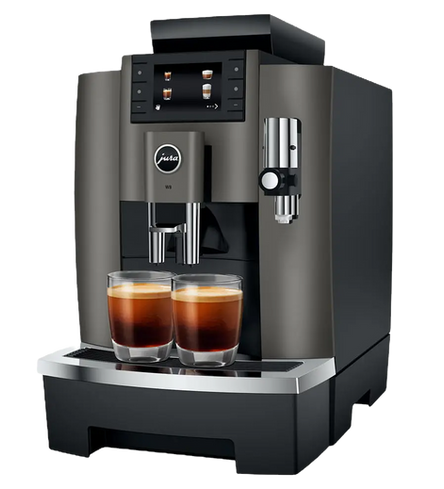 Compact • tank-fed | JURA X10 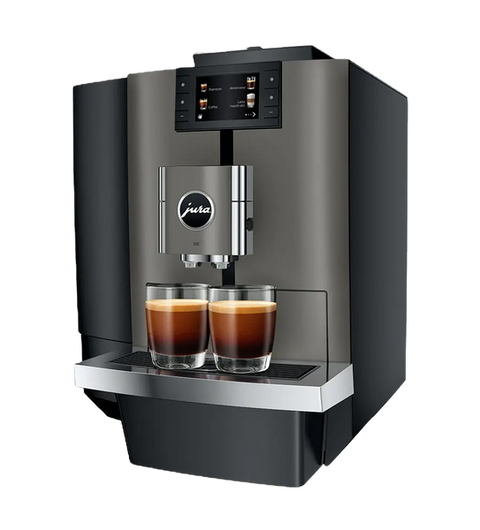 Higher daily class • Cold Brew |
Start with the requirement Before comparing packages, write down your busiest recurring day, the main drinks people order, the busiest half-hour and who will refill and clean the machine. Those four answers make this comparison much more useful.
JURA W8 vs X10 at a glance
The table compares W8 Dark Inox INTA (15663), X10 Dark Inox INTB (15781) and, where noted, X10c Dark Inox EA (15624). Specifications were checked against JURA UK on 7 October 2026. On a phone, swipe the table sideways to view every column.
Buying factor | JURA W8 | JURA X10 / X10c |
|---|---|---|
Daily coffee class | Recommended maximum: 50 | Recommended maximum: 100 |
Water | 3L tank; manual filling | X10: 5L tank. X10c: mains connection; 2.8L auto-filled tank |
Menu | 17 specialities; hot black and fresh-milk coffee | 34 specialities on the versions cited; hot and cold-extracted choices |
Milk storage | Separate chilled milk supply | Separate chilled milk supply |
Beans / grounds | 500g hopper; approx. 25 grounds portions | 500g hopper, optional 1kg extension; approx. 40 grounds portions |
Interface | 3.5-inch colour display with buttons | 3.5-inch colour display with buttons |
Dimensions: W × H × D | 29.5 × 44.3 × 44.6cm | 37.3 × 47 × 46.1cm; height 52.4cm with hopper extension |
Main buying reason | Lower-demand fresh milk in a narrower footprint | More daily headroom, Cold Brew or X10c water connection |
Daily figures are demand classes, not staff limits or promises of mixed-menu output. If the choice is mainly about attendance and coffees per day, use our guide to what size office coffee machine you need.
JURA W8: when compact fresh-milk coffee is enough
The JURA W8 makes sense where your team wants familiar hot coffee and milk drinks, the tea point has limited space, and normal busy-day usage sits comfortably within its daily class.
Think of a small professional practice, showroom or meeting area where people use coffee throughout the day. The W8’s menu covers espresso, black coffee and fresh-milk favourites such as cappuccino and flat white. A bigger menu is useful only if people want the extra choices.
A narrower machine also leaves more counter space for cups, ingredients and the milk cooler. Measure the whole setup, including access above the machine, rather than using the machine’s width as the complete installation footprint.
Step up when daily use regularly stretches the W8’s class, refilling becomes disruptive, or the office genuinely wants the X10’s additional menu. If your main complaint is a rush after meetings, first check whether the problem is preparation, cup handling or everyone arriving together.
JURA X10 and X10c: what the step up buys
The JURA X10 and X10c are relevant when the W8’s brief is too small. For an office making roughly 70–90 coffees on its usual busy day, it is sensible to assess the higher class rather than plan around a W8 already beyond its daily figure.
X10 combines the higher daily class with Cold Brew and a central dual spout. That can suit a shared self-service point where a broader menu is actually used. It also has more room for water and used grounds than the W8; the standard bean hopper is the same size unless you add the optional extension.
The X10c is the water-connection choice. Its automatic filling can be useful when carrying water to a busy point interrupts work. It still needs beans, milk, cleaning and waste attention. Plumbing does not turn it into a higher daily output class.
Generation matters JURA’s current cited X10 and X10c pages list 34 specialities, while other X10 material lists a different total. The cited X10 has nine cold-extracted choices; X10c lists eight. Confirm the exact supplied version and menu instead of choosing on a headline drink count.
When the W8 is the smarter buy
If your actual drinks menu, busy-day use and counter space all fit, the W8 can be the more proportionate investment. A reception coffee point making 25–35 drinks does not need an X10 merely because visitors see it.
Put the available budget into the parts the team will notice: suitable coffee, a milk cooler that suits usage, a clean tea point and a reliable handover. Paying for capacity or menu choices you will not use does not automatically improve the coffee experience.
W8 also avoids arranging a permanent water connection. That helps in rented premises, rooms that may move or locations without a sensible plumbing route. Remember that tank-fed X10 is an option too; lack of plumbing alone does not decide between W8 and X10.
When the X10 is worth the step up
The clearest reasons are sustained demand beyond the W8 class, a useful Cold Brew requirement, or an operational reason for the X10c connection. Planned growth can justify the step up when there is evidence behind it, such as additional desks coming into use.
For peak demand, resist the claim that a 100-coffee rating means twice the speed of a 50-coffee machine. JURA’s published standardised single-cappuccino figures are very close: 50 per hour for W8 and 51 for the cited X10. A daily rating and a queue calculation answer different questions.
Ask to test your intended recipes and cup sizes if service at arrival or after meetings is decisive. Two well-placed tea points may solve a concentrated queue better than one upgraded central machine.
Realistic W8-or-X10 workplace scenarios
These are planning examples, not manufacturer staff capacities or customer case studies.
20–30-person professional or hybrid office
A company with 30 staff but 20 attendees taking two coffees each, plus five visitors, makes 45 coffees. W8 can be a candidate after checking peaks. If all 30 attend on the same assumptions, 65 points towards X10. Headcount alone would have hidden that difference.
30–50-person office
An office making 80–90 coffees over a busy day has a stronger reason to assess X10. Fifty attendees taking two coffees plus ten visitor coffees make 110; neither featured daily class covers that example. Do not stretch the X10 merely to keep a two-model shortlist.
Growing or client-facing workplace
A confirmed increase from 35 to 75 daily coffees can justify X10 now. A client lounge remaining at 30 does not need it just to look premium. Cold Brew may be meaningful for hospitality, but ask whether guests will use it and whether staff can support the menu.
Mains water, awkward plumbing or heavy milk use
An approved water route at a busy fixed point supports considering X10c. An awkward route in a temporary office supports keeping tank-fed options on the shortlist. A latte-heavy team needs a sensible milk-replenishment plan whichever model it chooses; changing the coffee machine alone may leave the same milk bottleneck.
Tank-fed versus plumbed: the practical decision
W8 and X10 require someone to fill their tanks. Larger cups, americanos and rinsing all affect refill frequency, so dividing tank litres by your espresso size gives a misleading answer.
X10c needs a suitable water supply and specialist installation. Check filtration, safe isolation, access and any waste/drain arrangement for the actual package. Use the OBS 2-minute installation site check before finalising the counter.
Measure the milk cooler, service access and overhead clearance as well as the machine. The optional X10 bean extension changes its height. A plumbed coffee machine also does not automatically replace a separate tea-water source.
Milk cooler, cleaning and daily management
The live OBS Quote Builder offers Cool Control 1L and 2.5L choices in a W8 package and equivalent choices for X10. A bigger cooler can reduce milk refills, but it takes space and still needs a hygiene routine. Choose around milk volume rather than company size.
Assign responsibility for opening checks, fresh water where applicable, beans and milk, waste emptying and the end-of-day clean. Keep cleaning products available and train a second person so the routine does not depend on one colleague.
Both models provide cleaning programmes. Those programmes still require the operator to follow prompts, supply the correct cleaner and care for removable parts. Clean the milk system daily when milk has been prepared, following the exact machine manual; a rinse is not a substitute.
Neither is a maintenance-free workplace solution. If chilled milk and daily milk-path care are a poor fit, read the fresh-milk versus powdered-milk comparison before choosing.
What if neither machine is right?
Keep the W8-versus-X10 decision focused. If your requirement falls outside it, change the shortlist rather than force a compromise.
Black coffee only: compare JURA W4 for a lower-demand point, or assess X4 for a higher black-coffee class. A fresh-milk system you will never use may add little value.
More daily demand or multiple floors: assess GIGA X3 / X3c, GIGA X8 / X8c or a distributed setup. Use the size guide to map each point’s demand; a larger central machine is not automatically the right layout.
Powdered milk or integrated chocolate: assess the specified Gaggia G100 or G300 configuration. Neither featured JURA has an automatic chocolate-powder system.
Higher-demand fresh milk with chocolate or two milk routes: consider an appropriate Gaggia G700 configuration. This is a larger class of equipment, so space, total demand and cost need to justify it. Do not assume a fresh-milk G100 automatically supplies chocolate.
For a wider shortlist beyond these two models—GIGA capacity, Gaggia powdered-milk service or a specified hot-chocolate route—compare JURA and Gaggia office coffee machines by workplace requirement.
Purchase versus lease: compare complete packages
OBS’s live product pages show machine starting purchase prices of £1,390.12 + VAT for W8, £2,186.37 + VAT for X10 and £2,518.15 + VAT for X10c, checked 7 October 2026. These are starting equipment figures; confirm the exact included items and current quote.
Compare like for like: the same milk cooler, installation scope and support choices, with the model difference clearly shown. A weekly headline payment can conceal a longer commitment. Check the total payable, term, lender conditions and end-of-term ownership provisions.
The builder offers purchase, three-year and five-year options. Warranty, extended warranty and service are separate scopes; the written proposal determines cover. Use the office coffee machine leasing guide for the contract checks and the cost-per-cup calculator to model ingredients and running costs.
Your buying decision
Choose the W8 if… Your usual busy day fits the lower daily class; you want familiar hot fresh-milk coffee; a compact tank-fed setup suits the room; and neither Cold Brew nor a permanent water connection is a firm requirement.
Choose the X10 if… You need the higher daily class, have checked the actual peak, and will benefit from its menu or refill flexibility. Choose X10c when an approved permanent water connection adds practical value.
Frequently asked questions
What is the main difference between the JURA W8 and X10?
The W8 is the smaller tank-fed choice in JURA’s 50-coffee daily class. X10 is in the 100-coffee class, with a larger tank and Cold Brew. X10c adds a permanent water connection. Choose around demand, space and the menu you will actually use.
Is the JURA X10 worth the extra cost over a W8?
It can be when the W8’s daily class is too small, water refilling disrupts the workplace, or Cold Brew is a firm requirement. Where a W8 comfortably meets the brief, paying more for an X10 may add little practical value.
Can the JURA W8 be plumbed in?
The W8 compared here is tank-fed. For a factory mains-water model in this comparison, assess the X10c and confirm the installation requirements for the intended location.
What is the difference between X10 and X10c?
X10 uses a manually filled 5-litre tank. X10c connects to mains water and has a 2.8-litre tank that fills automatically. Both are in the 100-coffee daily class. Check the exact generation and menu before ordering.
Is a W8 enough for a 30-person office?
Possibly, depending on attendance and coffee use. Twenty attendees taking two coffees plus five visitor drinks make 45; thirty attendees taking two plus five make 65. These examples point to different machine classes despite the same company headcount.
Do both machines need a milk fridge?
For a workplace fresh-milk package, plan suitable chilled milk storage and daily cleaning. OBS’s builder offers Cool Control 1-litre and 2.5-litre options for W8 and X10. Select the cooler around milk use and refill intervals.
Can W8 or X10 make hot chocolate?
Neither featured model includes an automatic chocolate-powder system. If integrated hot chocolate is essential, assess a suitable Gaggia configuration instead of assuming that a fresh-milk JURA supplies it.
Does the X10 eliminate morning queues?
No. The higher daily rating does not guarantee a particular queue length or twice the speed. Recipes, arrival patterns, cup handling and milk demand all matter; test the planned menu when peak service is important.
Build and compare your W8 or X10 package
Start with the model that meets the brief, then add your cooler, installation and support choices. Build a W8 package or build an X10 package in the OBS Quote Builder. Each link selects its machine; you can return to the finder to compare the wider range.
For X10c, confirm the mains-water version and site requirements with OBS when requesting your quotation. Keep your daily use and busiest-period notes to hand: this article does not transfer a demand calculation into the builder. You can also browse all OBS office coffee machines.
Sources and comparison scope
Checked 7 October 2026: JURA UK W8 specifications, X10 INTB specifications and X10c EA specifications.
Daily care is based on JURA’s W8 instructions and X10 instructions. Package options and starting prices were checked on the live OBS pages and builder. Scenarios and buying judgements are illustrative OBS guidance.

Comments