
How To Choose The Right Office Coffee Machine Based On Daily Coffee Consumption

Updated: 1 day ago
For worked examples covering 20, 50, 100 and 200+ staff, read our office coffee machine size guide.
One of the biggest mistakes businesses make when choosing an office coffee machine is focusing solely on the number of employees.
While headcount is important, it rarely tells the full story.
A 30-person law firm can easily consume more coffee than a 100-person technology company operating a hybrid working model.
Before investing in a workplace coffee solution, it's worth understanding your expected daily coffee consumption. Choosing a machine that is too small can lead to queues, poor user experience and unnecessary service callouts. Choosing one that is too large can result in paying for capacity you simply don't need.
Why Daily Drink Volume Matters More Than Employee Numbers
When selecting an office coffee machine, we always recommend starting with a simple question:
How many coffees will be served each day?
Based on our experience, around 75% of office staff drink coffee regularly, with most coffee drinkers consuming between 2 and 3 cups per day.
Using this as a guide:
Number of Employees | Estimated Daily Coffee Consumption |
20 employees | 30-45 drinks |
30 employees | 45-70 drinks |
50 employees | 75-115 drinks |
75 employees | 110-170 drinks |
100 employees | 150-225 drinks |
150 employees | 225-340 drinks |
Of course, every workplace is different. Visitor numbers, meeting room usage, company culture and hybrid working patterns can all significantly influence coffee consumption.
In our experience, businesses often underestimate coffee consumption. A workplace with 100 employees doesn't necessarily need a machine designed for 100 users. If around 75% of employees drink coffee and each person consumes 2-3 cups per day, that same workplace could easily be producing over 200 drinks daily. Understanding actual consumption is usually more important than looking at headcount alone.
Don't Forget Peak Demand
One factor that is frequently overlooked is when coffee is consumed.
For example, an office serving 150 coffees per day may appear suitable for a particular machine. However, if most of those drinks are prepared between 8:30am and 10:00am, capacity requirements become very different.
The morning rush is often a better indicator of machine suitability than daily drink volume alone.
We've seen offices choose a machine that was technically capable of producing the required number of daily drinks, only to experience queues every morning because most employees wanted coffee within the same 60-90 minute period. Considering peak demand can be just as important as considering total daily volume.
Do You Really Need A Dual Bean Hopper Coffee Machine?
One question we are often asked is whether an office needs a coffee machine with two bean hoppers.
The answer is: not necessarily.
Many businesses assume they need a dedicated hopper for decaf coffee, but in reality, decaf consumption is often much lower than expected.
A quick staff survey or a review of previous coffee orders can usually establish whether there is genuine demand for decaf coffee throughout the workplace.
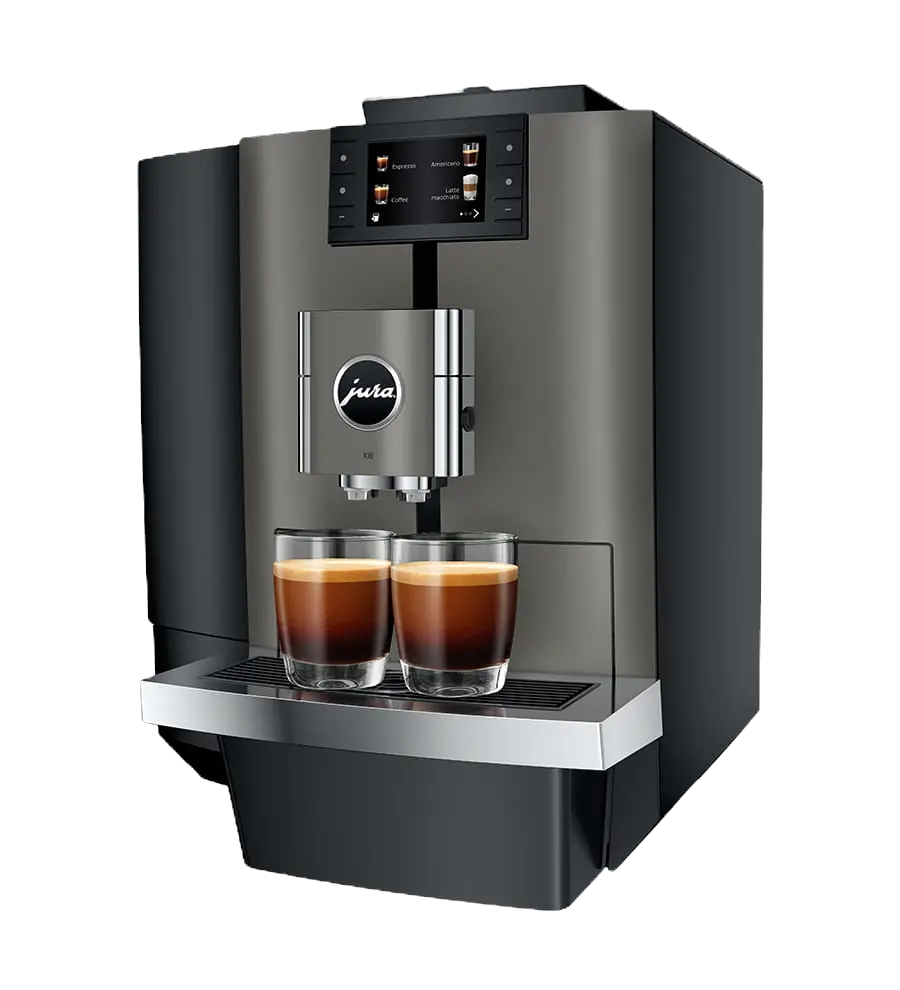
Machines such as the Jura X10 and Jura GIGA X3 include a bypass chute that allows pre-ground coffee to be used when required. This means occasional decaf drinkers can still be catered for without the additional cost of investing in a dual-hopper machine.
For many offices, this approach provides the best balance between functionality and value.
A dual bean hopper and grinder setup becomes more beneficial when:
Decaf coffee is consumed regularly throughout the day
Large numbers of staff require different coffee options
The workplace wants to offer multiple bean varieties, such as light and dark roast coffees
Drink volumes are high enough to justify the additional investment
The key is understanding how your employees actually drink coffee rather than selecting features that may never be used.
In many cases, businesses can achieve everything they need with a single-hopper machine and a small quantity of ground decaf coffee available when required.
Matching Machine Capacity To Workplace Demand
Every office is different, but as a general rule:
Office Coffee Machine For 20-30 Employees
Suitable for:
Small offices
Hybrid workplaces
Professional services firms
A machine such as the Jura X4, Jura W4, Jura W8, Jura X10 or the Saeco Magic M2 will comfortably support most environments of this size while providing a wide range of speciality coffee options.
Office Coffee Machine For 50-75 Employees
Suitable for:
Growing businesses
Busy accountancy firms
Legal practices
Corporate offices with regular visitors
This is often where businesses underestimate demand. Visitor traffic, client meetings and peak morning usage can significantly increase coffee consumption.
Depending on workplace requirements, the likes of the Jura X10, Jura GIGA X3/X3C or the Gaggia G100 and Gaggia G300 can be excellent solutions.
Office Coffee Machine For 100+ Employees
Suitable for:
Serviced offices
Larger corporate workplaces
Multi-floor offices
High visitor environments
At this level, speed, workflow and machine capacity become increasingly important.
Machines such as the Jura GIGA X8/X8C and the Gaggia G700 are designed to support higher demand environments while maintaining drink quality and consistency throughout the day.
The Right Machine Depends On More Than Volume
Daily drink numbers provide a useful starting point, but several other factors influence the best solution:
Fresh milk or powdered milk preferences
Available space
Water supply and drainage
Number of users
Visitor traffic
Budget
Future growth plans
Dietary requirements
The best office coffee machine is rarely the most expensive one. It is the machine that matches the way your workplace actually uses coffee.
Need Help Choosing The Right Office Coffee Machine?
Every workplace is different.
A 50-person law firm, a serviced office and a hybrid technology company may all have completely different coffee requirements despite having a similar number of employees.
Choosing an office coffee machine shouldn't be based purely on employee numbers or manufacturer specifications.
Understanding coffee consumption, peak demand and user preferences will help ensure you invest in a solution that delivers excellent coffee while remaining cost-effective for your business.
If you're unsure which machine is best suited to your workplace, contact Office Brew Solutions for tailored advice and recommendations.
Getting the sizing right from the start can save money, reduce downtime and ensure staff and visitors enjoy consistently great coffee every day.
Once you know your likely daily drink volume, compare office coffee machines by team size and capacity to shortlist the right models and see transparent purchase and lease pricing.
Comments