
7 Things to Consider Before Choosing an Office Coffee Machine

Updated: Sep 21

Coffee machines are often one of the last things considered during an office fit-out.
Unfortunately, that's usually when problems start.
By the time somebody begins looking at office coffee machines, the kitchen has often already been designed, cupboards installed, worktops fitted and electrical works completed. What looked like the perfect machine on paper can suddenly become difficult or expensive to install.
Over the years, we've seen a number of common mistakes that can easily be avoided with a little planning. If you're involved in an office fit-out, refurbishment or workplace project, here are seven things worth considering before choosing a workplace coffee machine.
1. Don't Choose a Machine Based on Today's Headcount Alone
One of the most common mistakes is selecting a machine based on current employee numbers rather than where the business expects to be in 12–24 months.
A coffee machine that comfortably serves 20 people today may struggle when the office grows to 40 or 50 employees.
It's worth considering:
Planned headcount growth
Visitor numbers
Meeting room usage
Future expansion plans
A slightly larger office coffee machine today is often far more cost-effective than replacing an undersized machine a year later.
2. Check the Clearance Above the Machine
This sounds obvious, but it catches people out surprisingly often.
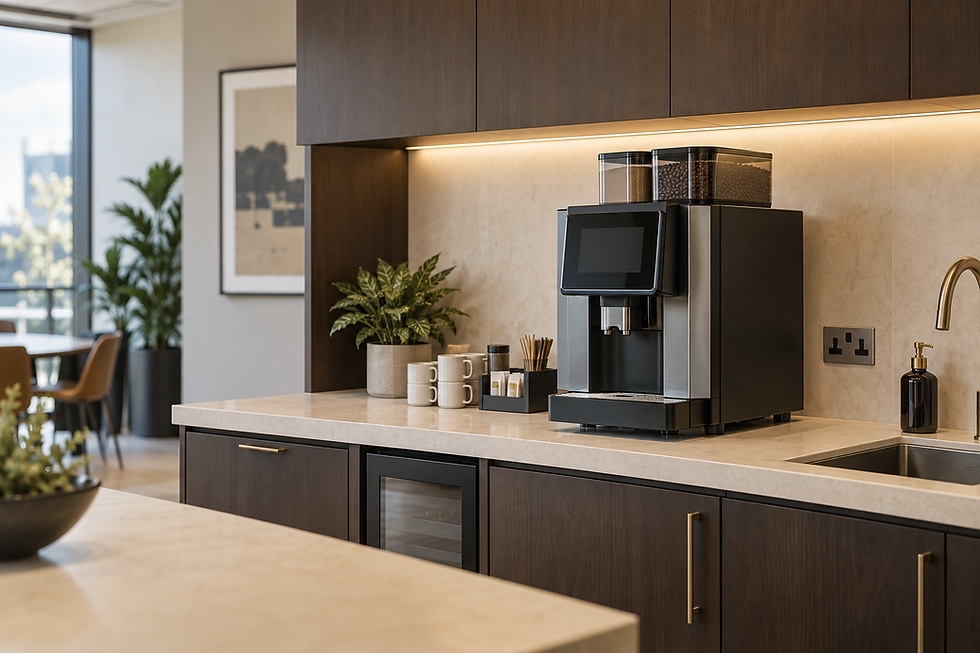
Many bean-to-cup office coffee machines require enough clearance above the machine to remove bean hoppers, refill ingredients and carry out routine cleaning.
We've seen installations where the machine physically fits on the worktop, only to discover there's not enough space between the worktop and the wall cupboards above.
Before choosing a machine, always check:
Machine height
Cupboard clearance
Access for refilling beans and ingredients
Access for servicing
It can save a lot of frustration later.
3. Consider Plumbing Early
Not every workplace coffee machine requires a water connection, but many larger office coffee machines perform best when plumbed directly into the mains water supply.
If a machine is being specified late in the project, plumbing routes may already be fixed, making installation more complicated than it needs to be.
Questions worth asking early include:
Is a mains water connection available?
Is drainage required?
Is there space for filtration equipment?
Would a tank-fed machine be more practical?
A plumbed installation also allows for the use of a scale reduction water filter. This is particularly important in many parts of the UK where hard water can lead to limescale build-up inside coffee machines.
While no filter can completely eliminate limescale, the right filtration can significantly reduce scale formation, help protect key machine components and improve long-term reliability. It can also reduce the frequency of descaling and maintenance visits over the life of the machine.
These decisions are usually much easier to make before the kitchen is completed than after the office is occupied.
4. Think About the Worktop Material
This is something many people don't consider until installation day.
If you're planning a plumbed coffee machine, holes may need to be drilled through the worktop for water, waste or power connections.
Stone, quartz and composite worktops can be particularly challenging to modify once installed.
Where possible, it's often easier and cleaner for any required cut-outs to be completed off-site during fabrication rather than trying to drill finished surfaces in a live office environment.
It's a small detail that can save time, cost and disruption.
5. Decide What's More Important: Convenience or Drink Variety
Every workplace is different.
Some offices want a simple, reliable coffee machine with minimal daily maintenance requirements. Others want a wider range of drinks and a more premium coffee experience for staff and visitors.
There is no universal right answer.
The best solution depends on:
Daily usage
Available staff resource
Cleaning expectations
User preferences
Budget
Modern office coffee machines can accommodate both approaches, whether that's a convenient granulated milk system or a fresh milk solution offering a wider drink menu.
The important thing is understanding the trade-offs before making a decision.
6. Don't Focus Only on the Machine Cost
The cheapest coffee machine isn't always the most cost-effective solution.
When comparing options, it's worth considering:
Reliability
Maintenance requirements
Service support
Ingredient costs
Expected lifespan
Downtime risk
The true cost of ownership is often very different from the initial purchase price.
We've seen businesses save money by investing slightly more upfront in a machine that's better suited to their environment and usage levels.
7. Choose the Right Office Coffee Supplier, Not Just the Right Machine
The machine itself is only one part of the solution.
A good office coffee supplier should help identify potential installation issues before they become problems.
That includes reviewing:
Available space
Plumbing requirements
Electrical requirements
Future growth plans
User expectations
The right supplier should help specify the most appropriate solution for the workplace, rather than simply recommending the most expensive machine available.
Final Thoughts
A successful workplace coffee solution starts long before the machine arrives on site.
By considering practical factors such as cupboard clearance, plumbing, water filtration, worktop materials and future growth early in the fit-out process, businesses can avoid unnecessary costs and create a better experience for both employees and visitors.
Whether you're planning a new office fit-out, workplace refurbishment or reviewing an existing coffee setup, taking the time to ask the right questions upfront can make all the difference.
Every Workplace Is Different
The right solution for a 20-person office may be completely different from what's needed in a 100-person serviced office or client-facing workspace.
Factors such as available space, plumbing, maintenanceexpectations, drink preferences and future growth all play a part.
If you're currently planning a fit-out or workplace refurbishment and would like a second opinion, feel free to get in touch.
Comments