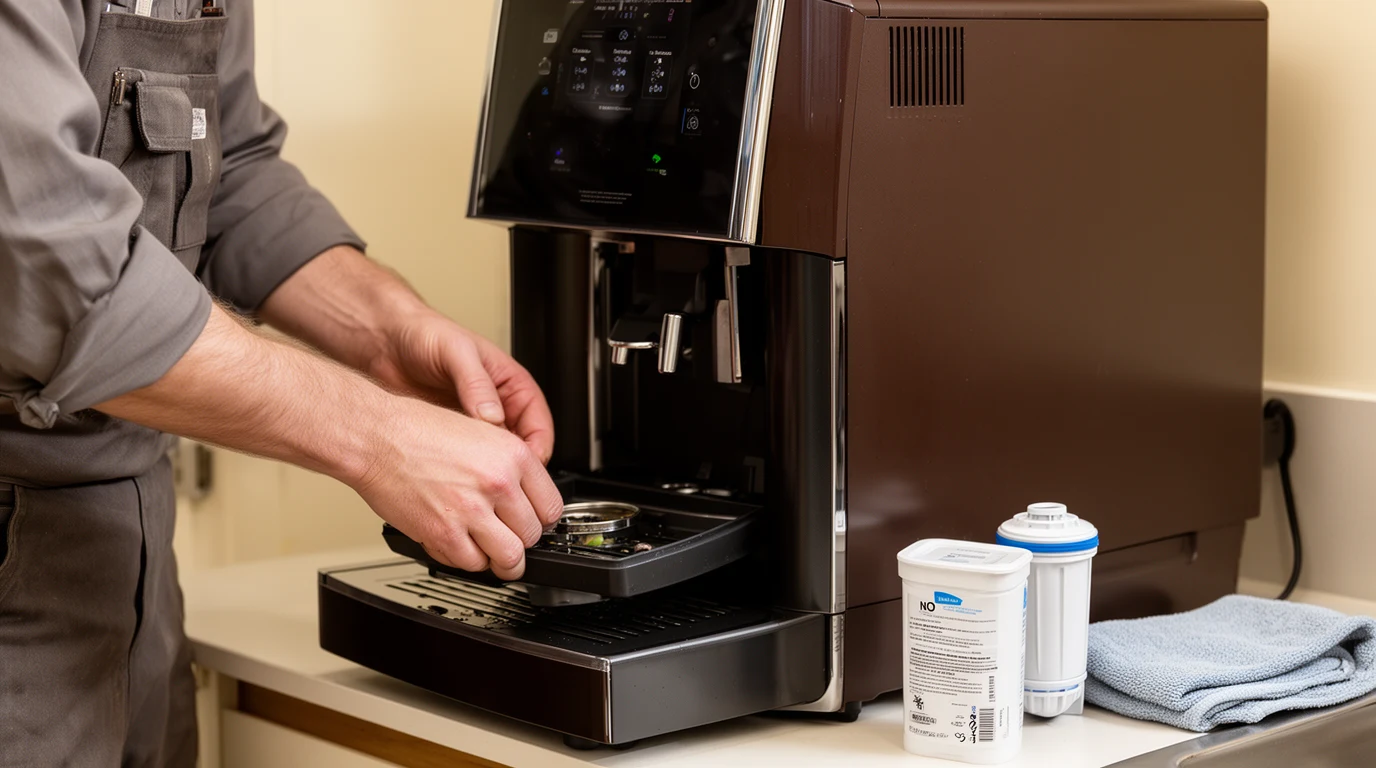

Yes, a fresh-milk office coffee machine needs cleaning every day you use milk. The automatic programmes handle much of it, but someone still has to add the cleaner, wash the removable parts and look after the milk container or fridge.
That doesn’t have to be a reason to avoid fresh milk. It does mean deciding who will clean the machine before you buy one. Here’s what’s involved with JURA and Gaggia machines, what the cleaning supplies might cost, and how to keep enough stock without over-ordering. Use this alongside the instructions for your exact model and milk system.
What needs cleaning every day?
Milk circuit: complete the required detergent clean, rather than relying on the quick water rinse.
Milk container and cooling unit: follow their cleaning and storage instructions, remove residues and check milk expiry.
Grounds and liquid waste: empty and clean regularly, before containers overflow.
Water and accessible surfaces: follow the machine instructions; keep the drinks area clean and wipe the display with an appropriate cloth.
Coffee system: follow the model-specific wash schedule and prompts. JURA and Gaggia schedules are not interchangeable.
Give one person responsibility for cleaning, with someone else covering holidays. A simple tick sheet helps, but only mark the job done once the programme has finished and the other daily tasks are complete. Follow any earlier cleaning prompts too.
JURA and Gaggia: the routine depends on the model
JURA W8: daily milk care, with separate coffee cleaning
The W8 manual requires daily milk-system cleaning when milk has been prepared and recommends weekly dismantling and rinsing of the fine-foam frother. It prompts for the coffee-cleaning programme after 180 preparations or 80 switch-on rinses; that programme lasts approximately 20 minutes. These are W8 instructions, not a universal timetable for every JURA.
If you are choosing equipment, compare the JURA W8 and JURA X10. For an existing machine, check its exact generation and maintenance instructions before choosing products or a care pack.
Gaggia G700: include both milk and brewer washes
The G700 instructions specify milk-circuit cleaning every 24 hours and a guided milk wash at the end of the day, or more often with use. They also recommend the brewer wash at the end of the day, or more frequently as required. The milk tank must be emptied of residues and sanitised daily.
Mixer parts need sanitising at refills and/or weekly, sooner where conditions require. Instant-drink ducts and nozzles need weekly or more frequent sanitising. The manual is clear that automatic washes do not replace regular parts removal and sanitisation by trained personnel. For EvoMilk, do not pour hot water into the wash tray: the module heats the solution itself.
A Gaggia G700 with DualMilk needs the routine for its fitted system and both milk paths. Do not assume two milk options mean a fixed double dose or an allergen-free changeover. Confirm the actual procedure and cleaner label.
Gaggia G100 and G300: check fresh or powdered milk
The Gaggia G100 is available in fresh- and powdered-milk configurations. Its fresh-milk model has PrimeMilk automatic cleaning; the G100 manual also states that the milk circuit must be cleaned every 24 hours. Powdered-milk configurations avoid a fresh-milk circuit but still have a brewer, mixers and outlets to maintain.
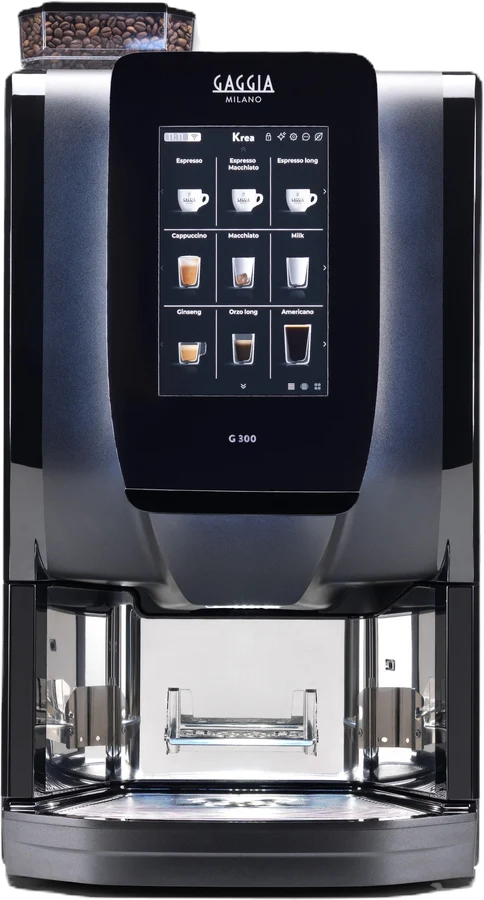
The Gaggia G300 is a powdered-milk option. Evoca publishes separate G300 tutorials for complete cleaning, tubes and nozzles, and ingredient canisters. Follow the actual G300 documentation rather than borrowing a fresh-milk G700 schedule.
How much staff time should you allow?
There are two different things to allow for: the time someone spends doing the job, and the time the machine spends running its programme. Adding cleaner, setting up containers, wiping surfaces and washing parts all need a person. The machine then does its part. The G700 manual describes guided washes taking several minutes; the W8 coffee-cleaning programme takes about 20 minutes. Neither is a promise for the whole daily routine.
At installation, run through the full clean and time it on your own machine. Include the fridge and any powder mixers, then agree when it will happen and who will do it. That gives you a more useful answer than a blanket “two minutes a day”.
What should you budget each month for cleaning supplies?
Milk cleaner is only part of the bill. Allow separately for coffee-cleaning tablets, filters or descaling, and staff time or servicing. Each product has a different job. Use the cleaner approved for your machine, rather than swapping JURA and Gaggia products.
JURA milk-cleaner costs: an example for 22 working days
For an office using milk on 22 days a month, here’s a useful starting point. JURA lists 60 cleaning procedures from the 180g dispenser and 125 from the 375g refill. At OBS prices checked on 15 October 2026, one suitable milk clean per working day works out as follows:
Product | Pack ex VAT | 22 cleans ex VAT |
180g dispenser / 60 procedures | £23.49 | £8.61 |
375g refill / 125 procedures | £37.95 | £6.68 |
These figures show the value of the cleaner used, not a monthly subscription or order total. You still buy whole packs. Including 20% VAT, the monthly examples are £10.34 and £8.02. They exclude delivery, coffee-cleaning tablets, filters, staff time and any extra cleans. The refill is for customers who already have a compatible dosing bottle. Always use the dose specified for your machine.
Compare the JURA 180g milk-cleaner dispenser and 375g milk-cleaner refill. Product pages show current prices and compatibility; prices can change.
How much Gaggia cleaner should you keep?
Take a G700 used on 22 days a month. One end-of-day milk clean and one brewer wash each day means 22 of each cycle to plan for. Over three months that’s 66 of each; over six months it’s 132. Add any extra cleans and the routine needed before or after a closure. These numbers count cleaning cycles, not tablets.
To turn that into an order, you need the approved dose and the number of doses in a pack. Check the instructions for a DualMilk setup rather than assuming it uses twice as much cleaner. And don’t rely on the words “annual kit” alone: how long it lasts depends on how it’s used. Give us your Gaggia model and milk setup and we can help confirm the right supplies.
How to order without running out
Count usable complete doses left, not just how many tubs are on the shelf. Track milk and brewer cleaners separately.
Forecast the required cleans for your operating days and machine count, including extra cycles and the agreed shutdown/restart routine.
Use a confirmed delivery lead time and add a reserve for delays or extra use.
Reorder when remaining doses reach expected use during that lead time plus the reserve. Account for stock already ordered.
Round the order up to whole packs and check storage instructions and expiry dates. Review actual consumption after the first month.
For example, if an approved routine uses one dose per operating day, delivery takes five operating days and you choose a five-dose reserve, the reorder point is ten doses remaining. This is a planning example, not an OBS delivery promise. Increase the threshold for multiple machines, more frequent cleans or longer lead times.
For JURA, browse cleaning tablets and the W8 care pack or current tank-fed X10 care pack. Match the installed filter and machine generation. A care pack is a set of products, not automatically a three- or six-month supply.
Filters and descaling need their own plan
Filters don’t all last the same number of months. Check which cartridge is fitted, your water conditions, how much coffee you make and the manufacturer’s time limits. Follow the machine prompts too. Tank-fed and plumbed-in machines can have different filters, so check before reordering. Leave any technician-only work to your service provider.
Would powdered milk or black coffee be easier?
If you want fresh-milk drinks and someone can look after the machine, the cleaning routine is part of making that choice work. If nobody can take it on, a powdered-milk G100 or G300 is worth considering. There’s no fresh-milk storage or milk circuit to manage, although the brewer, powder mixers, pipes and nozzles still need cleaning.
For a black-coffee workplace, the JURA W4 has no integrated fresh-milk system to clean. It still needs normal coffee, water and waste care. Compare the trade-offs in our fresh milk vs powdered milk guide and use the office coffee cost-per-cup calculator to keep consumables within the wider budget.
Office coffee machine cleaning: common questions
Does an automatic rinse replace a milk-system clean?
No. A water rinse and a detergent clean are different jobs. Follow the full routine for your model, including washing the removable parts and milk container.
Can we just clean it once a week?
Not if your machine needs daily milk cleaning. The weekly jobs are extra, not a replacement. Before a longer closure, check what the manufacturer says to do before switching off and when you return.
Can we buy JURA supplies if our machine came from elsewhere?
Yes. You can order from our public webshop even if you bought your machine elsewhere. Just check the model and product numbers before buying. Equipment support through the OBS customer portal is for OBS-supplied machines only.
What if we are unsure which cleaner or filter fits?
Send us the model name and a photo of the product or filter you’re using now. If there are different generations of the machine, we’ll need to check that too. It’s better to ask before ordering the wrong pack. For a fault, contact your agreed service provider rather than opening the machine yourself.
For Gaggia supplies, browse the NW5800 fresh-milk cleaning kit and NW5801 powdered-milk cleaning kit. Check the kit against your exact machine and milk setup with OBS before ordering. Pack contents are listed on each page; how long they last depends on your cleaning routine.
Need supplies or a hand choosing a machine?
Already running a JURA? Browse genuine JURA care and cleaning products. Choosing a new machine? Tell us your drink requirements, expected demand and who will manage cleaning, so we can compare a practical fresh-milk, powdered-milk or black-coffee setup.
Shop JURA care & cleaningDiscuss your machine and cleaning routineYou can also build a workplace coffee quote. Product compatibility, installation and support scope are checked for the proposed solution.
Sources and machine instructions
Reviewed 15 October 2026. This is a planning guide, not a replacement for the original instructions, operator training or your site hygiene procedure. The G700 schedules come from supplied manuals T1463EN00, PDF pp. 7 and 17-22, and H1463EN02, PDF p. 12. Exact cleaner doses and fitted-system steps remain those on the approved product and machine instructions.
JURA W8 instructions | JURA 180g cleaner specification | JURA 375g refill specification
Gaggia G100 manufacturer information | G100 manufacturer manual, hosted by ManualsLib | Gaggia G300 manufacturer information | Gaggia G700 manufacturer information | Evoca Academy cleaning guides